
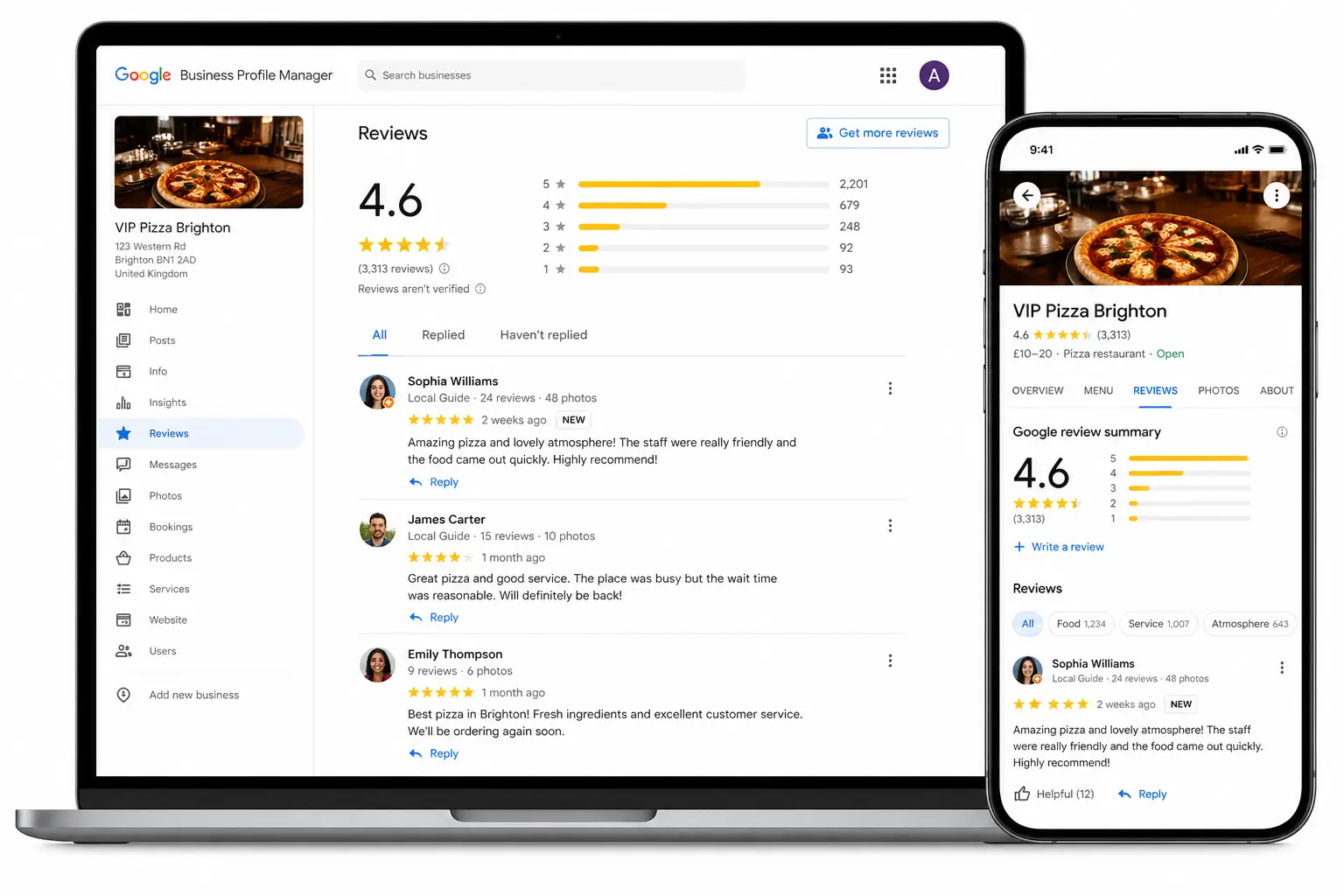
Google reviews have become one of the most powerful tools for attracting new customers. Whether you’re a local tradesperson, restaurant owner, solicitor, dentist, or online retailer, positive reviews help build trust, improve local search visibility, and increase conversions.
Yet many businesses struggle to collect reviews consistently. The good news is that most customers are willing to leave feedback—you simply need to ask at the right time and make the process as easy as possible.
In this guide, we’ll explain how to get more Google reviews, when to ask for them, and provide ready-to-use templates that can help boost your review count.
Why Google Reviews Matter
Google reviews influence both potential customers and Google’s local search algorithm.
Businesses with a strong review profile often benefit from:
- Higher visibility in Google Maps
- Better rankings in local search results
- Increased trust and credibility
- More website clicks
- More phone calls and enquiries
- Higher conversion rates
When customers compare two similar businesses, reviews often become the deciding factor.
The Biggest Mistake Businesses Make
Many businesses wait for customers to leave reviews naturally.
Unfortunately, even happy customers are busy and often forget.
The businesses that consistently generate reviews have a system in place. They actively request feedback from satisfied customers at key moments during the customer journey.
The key is asking at the right time.
The Best Time to Ask for a Google Review
Timing can dramatically affect your success rate.
Generally, you should ask immediately after a positive customer experience.
Great Times to Ask
After Completing a Job
For tradespeople and service businesses, ask once the customer has expressed satisfaction with the finished work.
Examples:
- Plumbers
- Electricians
- Roofers
- Landscapers
- Cleaners
The positive experience is fresh in the customer’s mind.
After a Successful Purchase
Retail businesses should ask shortly after a product has been delivered and the customer has had time to use it.
After Positive Feedback
If a customer says:
- “You’ve been brilliant.”
- “We’re really happy with the service.”
- “We’ll definitely use you again.”
This is often the perfect moment to request a review.
After Resolving a Problem
Customers who experience excellent customer service during a problem resolution can become some of your strongest advocates.
Make It Easy
The easier you make the process, the more reviews you’ll receive.
Always provide:
- A direct Google review link
- A QR code (for in-person businesses)
- Simple instructions
- A mobile-friendly experience
Never force customers to search for your business manually.
Reducing friction is critical.
Review Request Template: SMS
SMS messages often achieve excellent response rates because they are read quickly.
Example SMS
Hi [Name],
Thank you for choosing [Business Name]. We’re delighted that you’re happy with our service.
If you have a minute, we’d really appreciate a Google review. Your feedback helps other customers find us.
[Google Review Link]
Thank you for your support!
– [Business Name]
Review Request Template: Email
Email works particularly well for professional services and higher-value projects.
Example Email
Subject: Could You Spare 60 Seconds for a Quick Review?
Hi [Name],
Thank you for choosing [Business Name].
We hope you’re pleased with the service we provided. Customer feedback helps us improve and helps others feel confident when choosing a local business.
If you could spare a minute, we’d be grateful if you could leave us a Google review.
[Google Review Link]
Thank you again for your support. We truly appreciate it.
Kind regards,
[Your Name]
[Business Name]
Review Request Template: In Person
Sometimes the simplest approach is the most effective.
Example Script
“I’m really glad you’re happy with everything. If you get a chance later, we’d really appreciate a Google review. It helps us tremendously as a local business. I’ll send you the link to make it easy.”
This feels natural and avoids sounding pushy.
Follow-Up Review Template
Many customers intend to leave a review but simply forget.
A gentle reminder can significantly increase response rates.
Example Follow-Up
Hi [Name],
Just a quick follow-up regarding the Google review link we sent recently.
We completely understand you’re busy, but if you haven’t had a chance yet, we’d really appreciate your feedback.
Here’s the link again:
[Google Review Link]
Thank you for your support.
How Often Should You Follow Up?
One follow-up reminder is usually sufficient.
Avoid repeatedly chasing customers.
A recommended approach is:
- Initial request
- Wait 5–7 days
- Send one friendly reminder
After that, move on.
Over-pursuing reviews can damage customer relationships.
What Google Says You Shouldn’t Do
Google prohibits businesses from manipulating reviews.
Avoid:
- Buying reviews
- Offering cash incentives
- Offering discounts in exchange for reviews
- Posting fake reviews
- Asking employees to leave misleading reviews
- Filtering only positive reviewers
The best approach is always to ask all genuine customers for honest feedback.
Respond to Every Review
Getting reviews is only part of the process.
Responding demonstrates that you value customer feedback.
For Positive Reviews
Thank customers personally and mention specific aspects of their experience where possible.
For Negative Reviews
Remain professional and polite.
Avoid arguments.
Show potential customers that you’re willing to resolve issues constructively.
A well-handled negative review can sometimes improve trust more than a perfect five-star rating.
Build Review Requests Into Your Process
The most successful businesses don’t rely on memory.
Instead, they create a repeatable system.
Examples include:
- Automatic email requests after project completion
- SMS review requests after appointments
- QR codes on invoices
- Review links in email signatures
- Follow-up sequences in CRM software
When review requests become part of your workflow, growth becomes consistent.
How Many Reviews Do You Need?
There is no magic number.
However, businesses should focus on achieving:
- A steady flow of new reviews
- Recent reviews
- Genuine customer feedback
- Detailed reviews mentioning services provided
Twenty recent reviews are often more valuable than hundreds of reviews that are several years old.
Google values freshness as well as quantity.
Final Thoughts
Getting more Google reviews isn’t about luck—it’s about having a process.
Ask customers at the right time, make leaving a review simple, and follow up politely when necessary. Most satisfied customers are happy to help if you make the process easy.
By consistently requesting reviews through email, SMS, and in-person conversations, you can steadily build a strong review profile that improves trust, boosts local SEO, and helps your business attract more customers from Google Search and Google Maps.
The businesses with the most reviews aren’t always the ones providing the best service—they’re often the ones that simply ask consistently.
