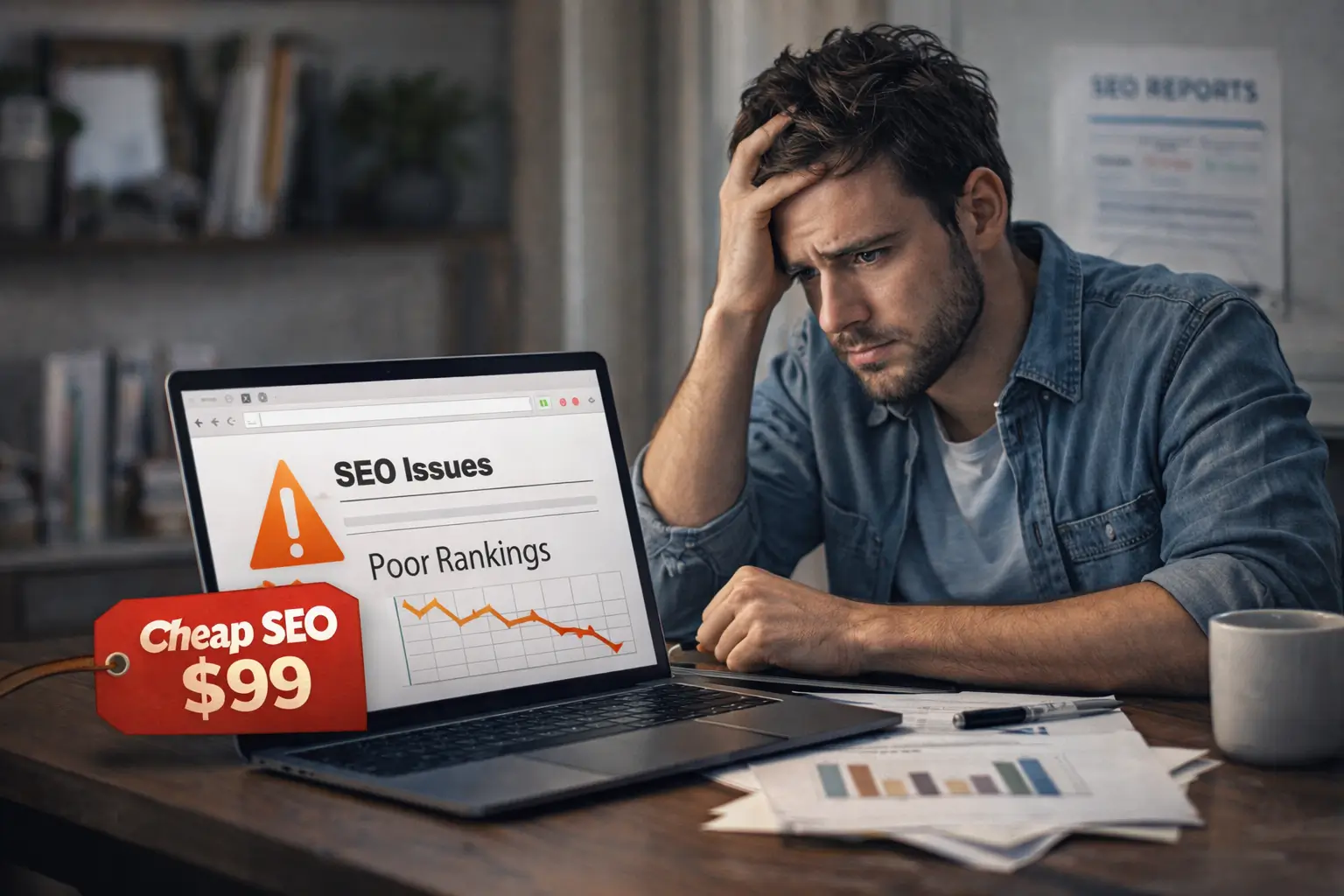
Every business wants affordable SEO.
Few calculate the long-term cost of choosing it.
Cheap SEO rarely fails dramatically.
It fails quietly.
Gradually.
Twelve months pass.
Reports show activity.
But visibility barely moves.
And competitors widen the gap.
Why Cheap SEO Feels Safe
Low-cost providers often promise:
- Regular content
- Monthly backlinks
- Ongoing optimisation
- Transparent reporting
On the surface, it looks like progress.
But without strategic direction, those actions lack leverage.
Not a checklist.
The Real Cost Isn’t Money – It’s Time
Search compounds over time.
If you spend 12–18 months building weak foundations:
- Authority remains thin
- Core pages don’t gain traction
- Competitors strengthen their lead
- Recovery becomes harder
You can’t buy back lost search momentum easily.
Time in SEO is expensive.
Competing in Serious Markets
If you operate:
- National ecommerce
- Competitive local services
- High-value B2B markets
You are not competing against hobbyists.
You’re competing against structured investment.
Affordable SEO often means:
- No technical depth
- Generic content
- Reactive adjustments
- Little authority planning
It creates motion.
Not progression.
A Better Question
Instead of asking:
“How much does SEO cost?”
Ask:
“What is ineffective SEO costing us?”
Because stagnation compounds.
And so does competitor advantage.
Structured Strategy Isn’t About Spending More
It’s about:
- Clear priorities
- Revenue alignment
- Technical clarity
- Authority development
- Intent-based targeting
That doesn’t require reckless spending.
It requires structure.
Final Thought
Affordable SEO often ends up being the most expensive option long-term.
Search should be built like infrastructure.
Deliberately.
Strategically.
Commercially.