
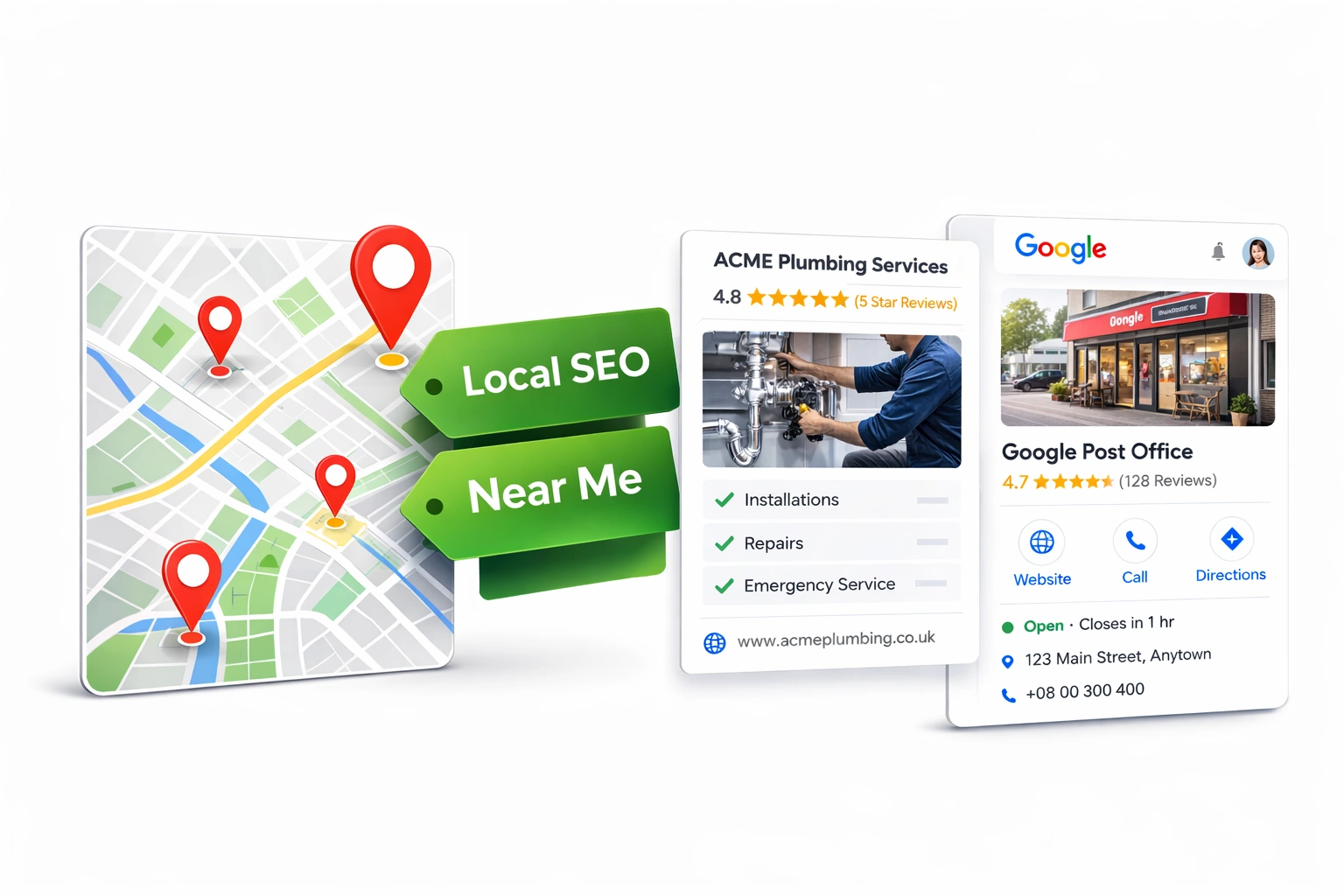
Local SEO is one of the most effective ways for businesses to attract customers who are actively searching for products and services nearby. Whether you’re a plumber, solicitor, dentist, accountant, roofer, or retailer, appearing prominently in local search results can generate a steady stream of highly qualified leads.
Yet many businesses focus solely on their Google Business Profile while overlooking some of the most important local ranking factors. Three of the biggest foundations of successful local SEO are citations, NAP consistency, and local landing pages.
This playbook explains how these elements work together and how you can use them to improve your local search visibility.
Why Local SEO Matters
When someone searches for terms like:
- “Electrician near me”
- “Roof repair in Manchester”
- “Accountant in Leeds”
- “Dentist in Bristol”
Google attempts to show the most relevant and trustworthy local businesses.
To determine which businesses deserve top rankings, Google evaluates a range of signals, including:
- Business information accuracy
- Online citations
- Customer reviews
- Website relevance
- Local content
- Backlinks
- User engagement
The stronger these signals are, the more likely your business is to appear in Google’s local pack, Google Maps, and organic search results.
Part 1: Citations – Building Trust Across the Web
What Are Local Citations?
A citation is any online mention of your business’s key information.
Typically, a citation includes:
- Business name
- Address
- Phone number
- Website URL
Google uses citations to verify that your business is legitimate and operates where it claims to operate.
Think of citations as digital references that support your business’s credibility.
Common Citation Sources
Examples include:
- Google Business Profile
- Bing Places
- Apple Maps
- Yell
- Thomson Local
- Scoot
- Yelp
- Industry-specific directories
- Local business directories
- Chamber of Commerce websites
The more consistent and trustworthy your citations are, the more confidence Google has in your business information.
Citation Building Checklist
✓ Claim existing listings
✓ Remove duplicate listings
✓ Update outdated information
✓ Submit to reputable directories
✓ Add your website URL
✓ Include business descriptions
✓ Upload photos where possible
✓ Regularly audit listings
Quality matters more than quantity. A few accurate, trusted citations are often more valuable than hundreds of low-quality directory listings.
Part 2: NAP Consistency – The Foundation of Local SEO
What Is NAP?
NAP stands for:
Name
Address
Phone Number
These three pieces of information should remain consistent across your entire online presence.
Google compares information from multiple sources. If your details differ from one website to another, confusion can occur.
Why NAP Consistency Matters
Imagine Google finds the following:
Website:
ABC Roofing Ltd
15 High Street
Manchester
0161 123 4567
Directory Listing:
ABC Roofing
15 High St
Manchester
0161 123 4568
Facebook Page:
ABC Roofing Services
17 High Street
Manchester
0161 123 4567
These inconsistencies can weaken trust in your business data.
Google may struggle to determine which information is correct.
Common NAP Problems
- Old phone numbers
- Previous business addresses
- Different business name formats
- Duplicate listings
- Inconsistent abbreviations
- Missing suite or unit numbers
While small variations aren’t always catastrophic, maintaining consistency helps strengthen local SEO signals.
NAP Audit Checklist
Search online for:
- Your business name
- Your phone number
- Your address
Then verify:
✓ Business name matches everywhere
✓ Address formatting is consistent
✓ Phone number is identical
✓ Website URL is correct
✓ Old listings are updated
✓ Duplicate entries are removed
Conducting a NAP audit once or twice per year can help prevent issues from developing.
Part 3: Local Landing Pages – Ranking in Multiple Areas
Many businesses serve several towns, cities, or regions.
A common mistake is creating a single generic services page and expecting it to rank everywhere.
Instead, successful local SEO campaigns often use dedicated local landing pages.
What Is a Local Landing Page?
A local landing page is a page designed to target a specific location.
For example:
- /electrician-manchester/
- /electrician-liverpool/
- /electrician-bolton/
Each page focuses on a particular area while maintaining relevance to the services offered.
Why Local Landing Pages Work
Google wants to deliver highly relevant results.
If someone searches for:
“Boiler repair in Leeds”
A page specifically discussing boiler repair services in Leeds is often more relevant than a generic national service page.
Local landing pages help search engines understand:
- Where you operate
- Which locations you serve
- The relevance of your services to those areas
What to Include on Local Landing Pages
Unique Content
Avoid copying and pasting the same content across dozens of pages.
Each page should include:
- Area-specific information
- Local landmarks
- Service details
- Customer examples
- Frequently asked questions
Location-Based Keywords
Naturally incorporate terms such as:
- Electrician in Manchester
- Roofing company in Leeds
- Plumber in Sheffield
Avoid excessive keyword repetition.
Write for users first.
Trust Signals
Include:
- Customer reviews
- Case studies
- Certifications
- Accreditations
- Before-and-after photos
These elements improve credibility and conversions.
Clear Calls to Action
Make it easy for visitors to:
- Call your business
- Request a quote
- Book an appointment
- Complete a contact form
Every local page should have a clear objective.
Common Local Landing Page Mistakes
Many businesses create pages that provide little value.
Avoid:
- Thin content
- Duplicate content
- Auto-generated pages
- Keyword stuffing
- Creating pages for locations you don’t genuinely serve
Google increasingly rewards quality and relevance over quantity.
How Citations, NAP and Landing Pages Work Together
The strongest local SEO campaigns combine all three elements.
For example:
Your website contains a dedicated “Plumber in Nottingham” page.
Your Google Business Profile confirms your Nottingham service area.
Your directory citations show the same address and phone number.
Your customer reviews mention Nottingham.
Together, these signals reinforce your local relevance and authority.
No single factor guarantees rankings, but consistency across all local SEO elements creates a strong foundation for success.
A Simple Local SEO Action Plan
Month 1
- Audit citations
- Correct NAP inconsistencies
- Claim missing directory listings
Month 2
- Optimise your Google Business Profile
- Add services and photos
- Improve business descriptions
Month 3
- Create local landing pages
- Add location-specific content
- Improve internal linking
Ongoing
- Generate customer reviews
- Publish local content
- Build local backlinks
- Monitor rankings and traffic
Small improvements made consistently often produce significant long-term gains.
Building Trust
Local SEO isn’t about finding a single ranking trick. It’s about building trust and relevance across the web.
Citations help verify your business information. NAP consistency ensures Google receives accurate signals wherever your business is mentioned. Local landing pages demonstrate relevance for the locations you want to rank in.
Together, these three pillars form the foundation of a successful local SEO strategy. Businesses that invest time in getting these basics right often outperform competitors who focus only on short-term tactics.
If your goal is to generate more local leads, improve Google Maps visibility, and attract customers from nearby searches, mastering citations, NAP consistency, and local landing pages is one of the best places to start.
This piece is structured to perform well for both informational searches and long-tail local SEO queries while positioning the reader toward professional local SEO services.
