Most businesses assume SEO fails because:
- Google changed something
- Competition increased
- Content isn’t frequent enough
In reality, SEO usually underperforms for a much simpler reason:
It was never structured around revenue in the first place.
There’s a difference between visibility and commercial performance.
A website can rank.
It can generate traffic.
It can show positive graphs in monthly reports.
And still fail to deliver meaningful business growth.
Because traffic doesn’t drive a business.
Revenue does.
The Traffic Obsession
SEO conversations often revolve around:
“How do we get more traffic?”
But that question is incomplete.
The better question is:
“How do we increase high-intent visibility that leads to sales or enquiries?”
If your site attracts visitors who were never going to convert, traffic becomes a vanity metric.
And vanity metrics don’t compound commercially.
Activity vs Structure
Many SEO campaigns focus on activity:
- Publishing blog content
- Adding service pages
- Building backlinks
- Optimising meta titles
All useful in isolation.
But without a structured commercial plan behind them, they lack cohesion.
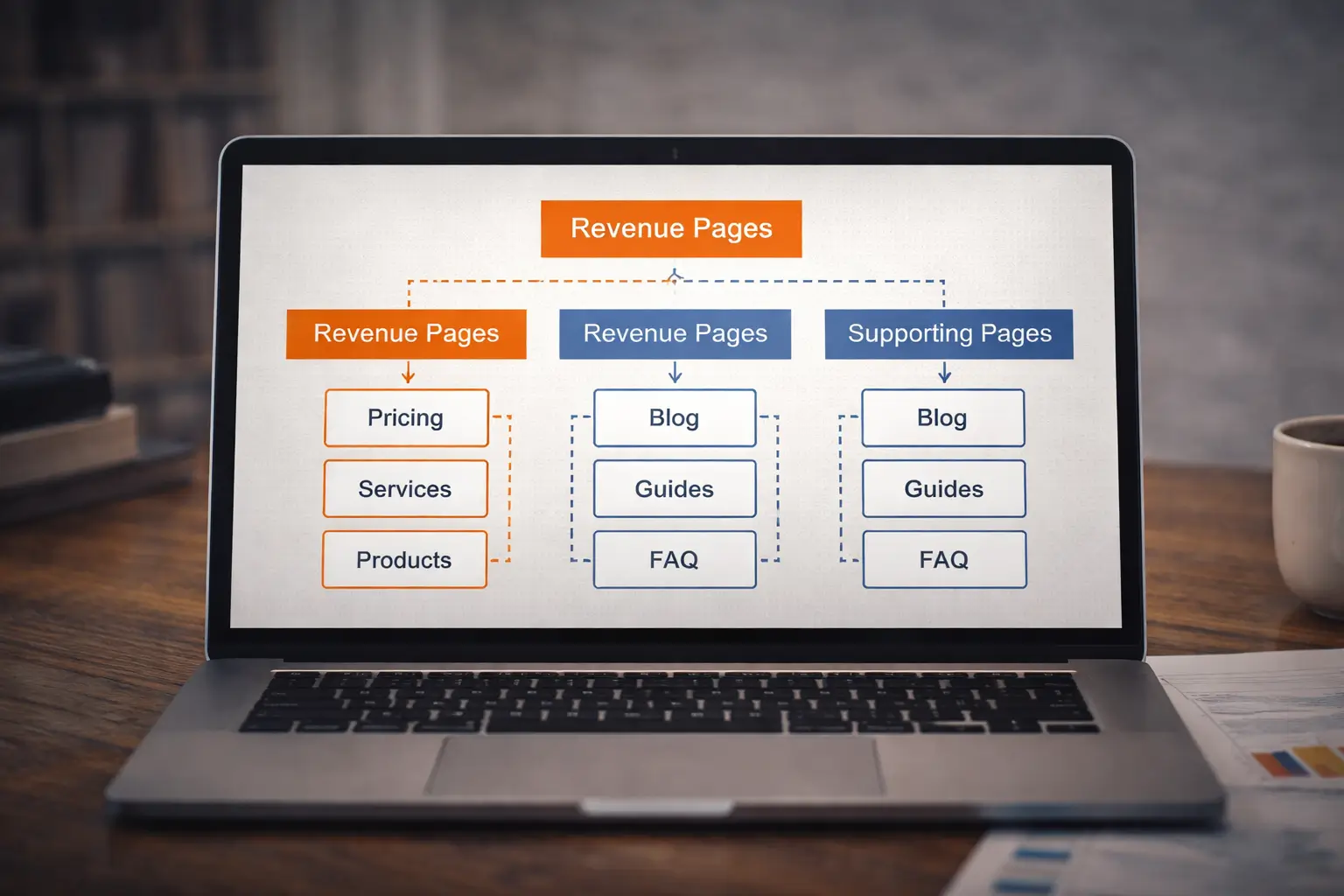
Structure means:
- Clear service or product hierarchy
- Intent-based page mapping
- Internal linking aligned to priority revenue pages
- Authority development supporting those pages
- Technical clarity that removes friction
Without that foundation, more activity simply amplifies inefficiency.
Why Revenue-Led SEO Looks Different
A commercially structured SEO strategy begins with:
- Identifying highest-margin services or products
- Mapping buyer intent across search behaviour
- Aligning page architecture to that intent
- Strengthening authority signals toward those clusters
It doesn’t start with “What keywords have the most volume?”
It starts with:
“What actually drives this business forward?”
That shift changes everything.
The National & Competitive Reality
For ecommerce brands or service businesses operating in competitive markets, this matters even more.
You’re not just competing on content.
You’re competing on:
- Structure
- Authority
- Brand signals
- Technical depth
- Internal linking logic
If your competitors have invested in structured search architecture and you haven’t, publishing more content won’t close that gap.
Structure scales.
Random activity doesn’t.
The Signs Your SEO Isn’t Structured
You might recognise this if:
- Traffic is rising but sales aren’t
- Rankings exist but for low-value terms
- Service pages struggle to break into top positions
- Blog content outperforms core commercial pages
- Reports look healthy but revenue feels flat
That’s not necessarily failure.
It’s misalignment.
The Fractional Advantage
Many growing national and local businesses don’t need a full-time SEO hire, which is where our SEO & AI Growth Agency for UK Businesses Services or SEO Services for Law Firms and Solicitors Services come into play.
They need structured strategic direction using current AI technology.
A fractional approach allows:
- Senior-level planning
- Commercial alignment
- Technical oversight
- Authority development
Without unnecessary overhead.
The focus shifts from “doing SEO” to building search as a predictable revenue channel.
To Conclude
If your SEO appears active but isn’t moving revenue, the issue is rarely effort.
It’s structure.
Search that delivers inquiries—or sales—is intentional.
It’s built around commercial alignment from the start.
And once structured properly, it compounds.